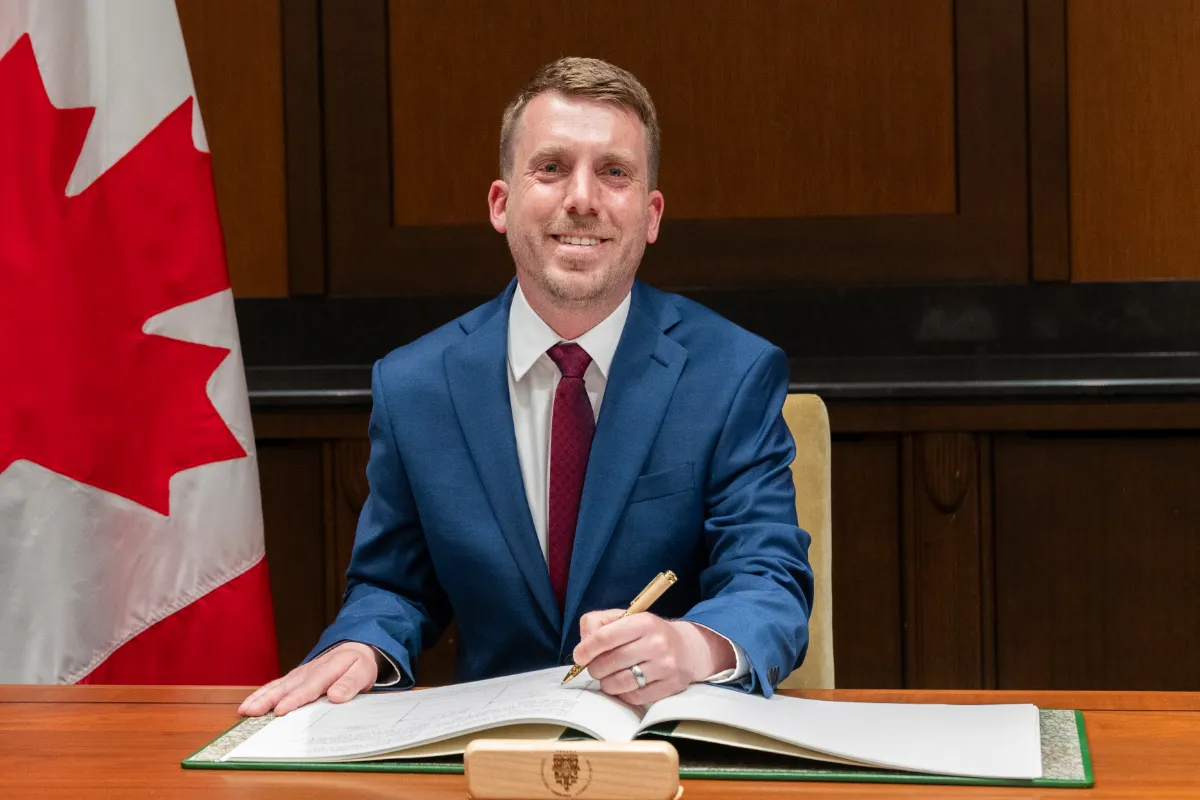
Today, I delivered my maiden speech in the House of Commons as the Member of Parliament for Sackville—Bedford—Preston, expressing deep gratitude to my constituents, family, and campaign team. In a heartfelt and forward-looking address, I reflected on the communities that shaped me, the values that guide my public service, and our government’s bold vision to build a more affordable, connected, and resilient Canada. My remarks emphasized collaboration over partisanship, action over cynicism, and a renewed belief in what government can achieve when it leads with purpose.
Read the speech below.
Mr. Speaker,
It is with a profound sense of gratitude and humility that I rise for the first time as a Member of Parliament in the House of Commons.
I want to start by thanking the good people of Sackville-Bedford-Preston who have placed their trust in me.
From my hometown of Bedford to Sackville to Fall River, Waverley, Wellington, Beaver Bank, Preston, and beyond, these communities have bestowed an honour on me that I can never truly repay.
My family, without whom I would not be here today, also deserve everlasting thanks.
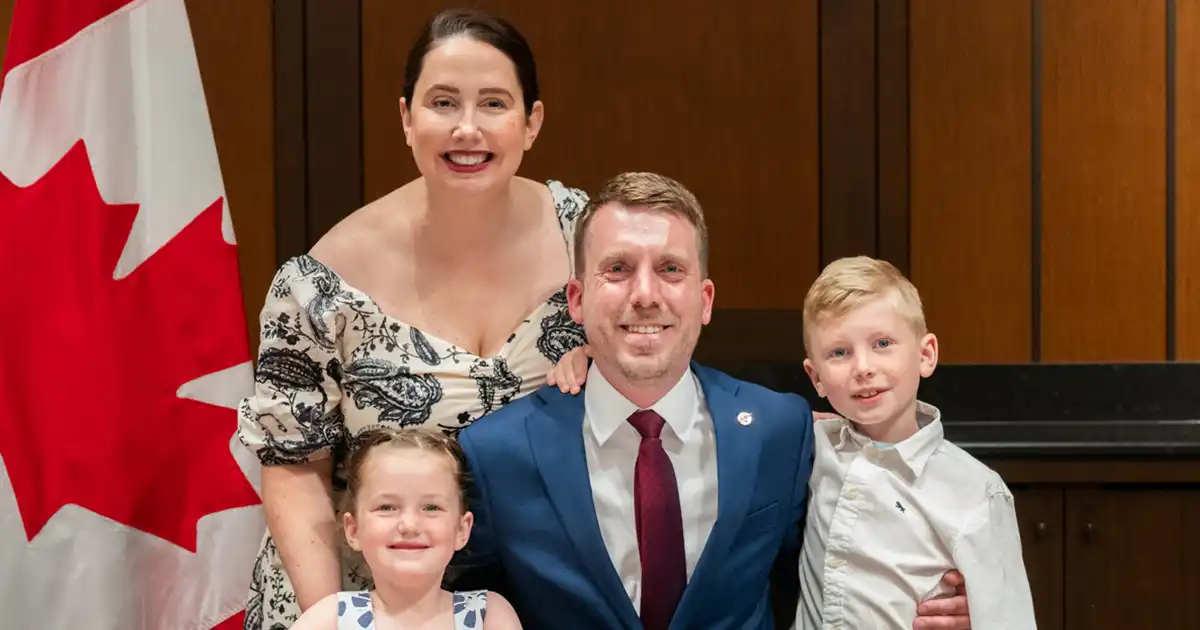
To my wife Caitie, who is the best person I’ve ever known—thank you for everything.
Thank you for taking a chance on the skinny kid from down the hall that first year at Dalhousie University. It’s been the ride of a lifetime, and there’s so much more to come.
To my kids, Beau and Heidi.
Daddy loves you and I can’t stand missing so many soccer games and playdates at the Barbie dreamhouse.
To my Mom and Dad and my siblings, Deidre and Travis.
Thank you for always believing in me.
And thank you to my predecessor, Darrell Samson, who was an exceptional MP for the past 10 years and whose advice and counsel was always wise.
Mr. Speaker, a political campaign is the sum of countless tiny acts of political courage – that first timid knock on a stranger’s door, that first phone call with an uncertain conclusion.
The sometimes-inexplicable decision to put your name on the ballot.
To my amazing campaign team, who knocked on thousands of doors and suffered through far too many days of damp Maritime weather, the kind of weather that seeps into your bones – our victory belongs to you more than it does to me.
Speaking on the second to last day of Address in Reply offers me an advantage compared to some of my colleagues who preceded me – the advantage of perspective and time.
It has now been one week since King Charles III delivered the Speech from the Throne.
In a mere seven days, the threads of that speech have begun to stitch together into a concrete vision of what our government plans to do.
We will make life more affordable by cutting taxes for over 22 million Canadians from coast to coast to coast.
For each of us in this chamber, that means thousands and thousands of our constituents will have more money in their pockets.
This will save the average two-income family $840 per year.
That’s enough for swim lessons or a well-deserved night out for tired and busy parents.
We will eliminate the GST on homes under $1 million for first time buyers, saving people up to $50,000.
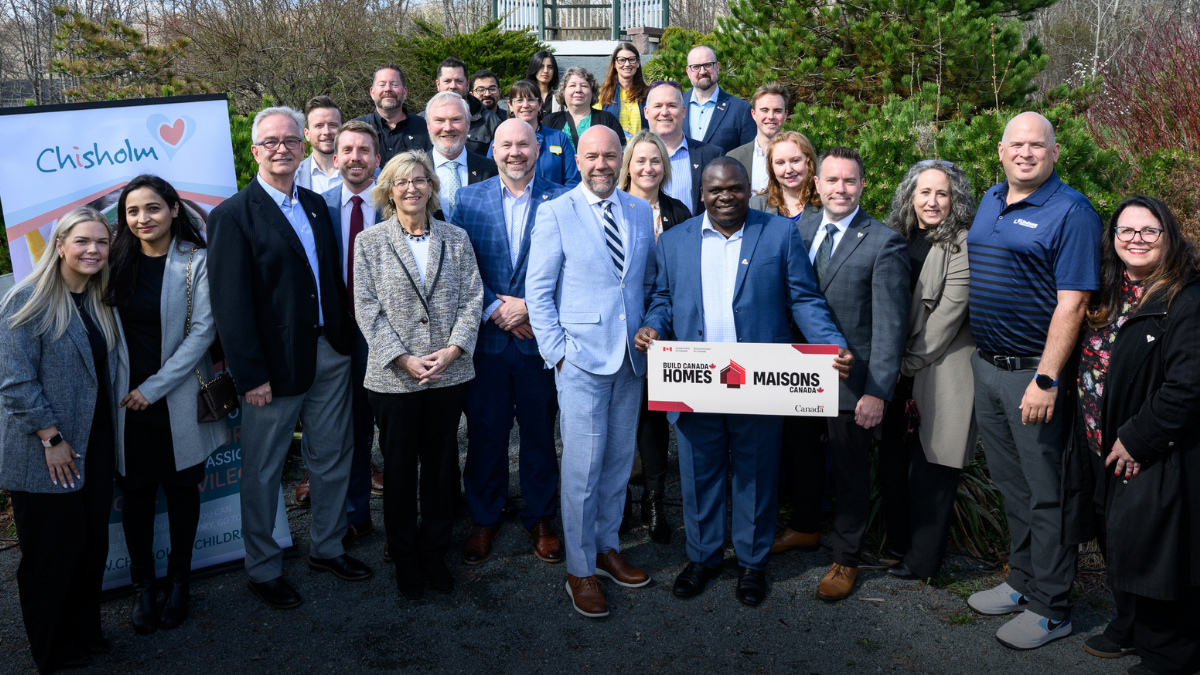
Through Build Canada Homes, we will embark on the most ambitious home building plan since the Second World War and deliver 500,000 new homes a year.
We will cut development charges in half, support modular and prefabricated housing, and simply make it easier and faster for people to have a safe, affordable place to live.
In partnership with provinces and territories, we will break down trade barriers and create true free trade in this country.
This will unlock up to $200 billion in economic activity and reduce our dependence on trade with the United States.
Coming out of the Prime Minister’s meeting with the Premiers in Saskatoon, it’s clear that there is consensus on this.
Progressive Conservative premiers, NDP premiers, and Liberal premiers alike all agree – one Canadian economy is much stronger than thirteen.
We will identify projects of national significance that will break down the silos of narrow political self-interest and generate economic growth across the country.
These projects will create jobs, diversify trade, and create a self-sufficient national economy that can weather the storms of an uncertain and changing world.
As was laid out in the communique from yesterday’s First Ministers meeting, we will identify:
“Nation-building infrastructure and corridors, such as highways, railways, ports, airports, pipelines, nuclear projects, clean and conventional energy projects, and electricity transmission systems that are crucial for driving Canadian productivity growth, energy security, and economic competitiveness.”
Under this plan, approvals that once took five years will now take two.
In a word, we will build.
And as we build, we will prove that government can do big things and do them well.
Many will be skeptical, and I can understand why.
Far too often, government has asked “why” instead of “why not”?
Instead of solving problems, government has thrown up roadblocks in front of good ideas.
But this is not inevitable or unchangeable.
If we look to the past, we are overwhelmed with examples of government, often in partnership with the private sector, building the foundations of our country, foundations that support us to this day.
When the last spike was driven to complete the Canadian Pacific Railway, it was the culmination of a dream that was, to borrow the Prime Minister’s phrase, Canada’s first project of national significance.
During the Second World War, the Bedford Basin, in my riding, was the gathering point for dozens of ships in convoys that would cross the ocean and liberate a continent.
In 1955, a ribbon of steel, rising gracefully above the water below, connected Halifax to Dartmouth for the first time – the Angus L. MacDonald Bridge.
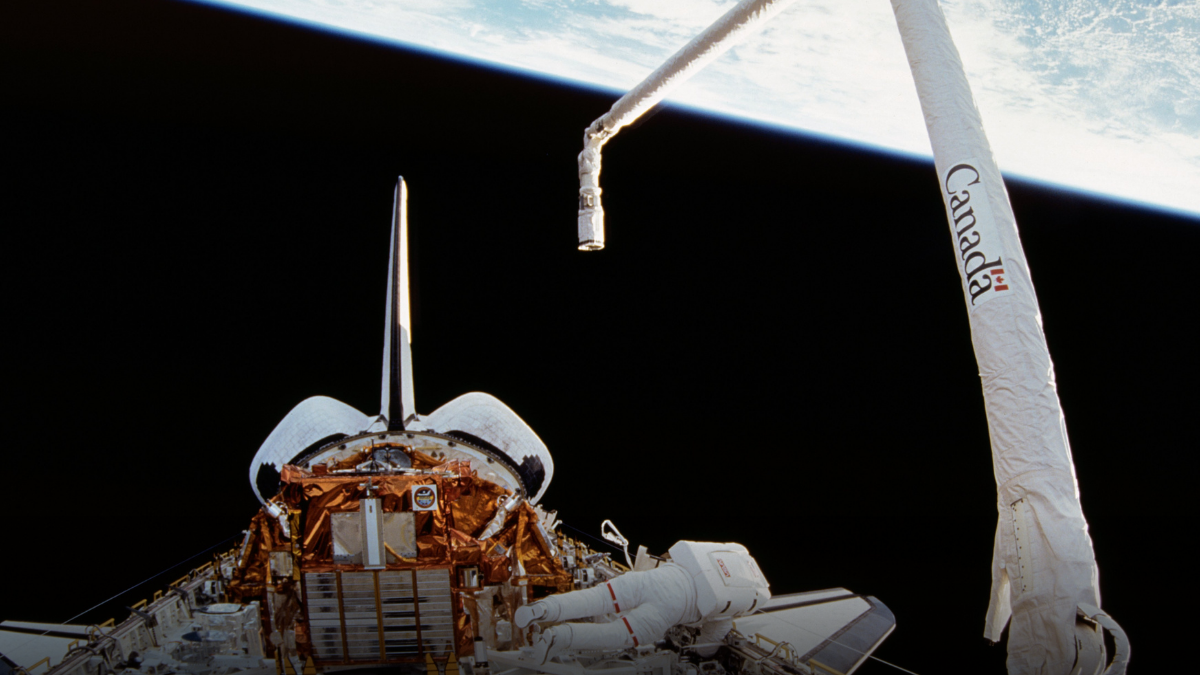
In 1981, the CanadArm entered the final frontier of space with the logo of the Government of Canada on its side, an extraterrestrial example of what government can achieve.
And in the years to come, I know more examples will emerge.
My hope is that this government—a government that builds—will restore Canadians’ faith that big things are not beyond our reach.
That government can be and must be a catalyst for growth, not a drag on innovation and productivity.
I also hope that this Parliament can be one defined by productivity instead of partisanship.
That MPs can work collaboratively and across party lines to get things done.
Mr. Speaker, as you know there is no more direct, insightful, and humbling experience than going door to door during a campaign.
As I’ve reflected on the campaign over the past several weeks, I’ve been struck most of all by what I *did not* hear when I met people at their doorsteps.
Nobody asked me to be angrier.
Nobody asked me to double down on cynicism and pettiness.
Nobody asked me to heckle more and heckle louder.
Nobody asked me to do those things because most people are lucky enough to live their lives outside of the political bubble.
They live in the real world, where the scoreboard is not measured in seat counts or vote totals, but in the feeling you get when you wake up in the morning with a sense of purpose and hope.
The feeling you get when you know your kids will be better off than you are.
This place exists in the real world, but sometimes it feels like stepping into the Twilight Zone.
Being in politics sometimes feels like being a racehorse with blinders on.
Your field of vision is so narrow that all you see and all you care about is what’s directly in front of you.
You lose sight of the great big world around you and become obsessed with narrow goals and small wins.
But Mr. Speaker, we all would serve our constituents better if we shed those blinders every once in a while and expanded our field of vision, even just a little bit.
I don’t pretend to be perfect, and I’m sure my blinders will come on from time to time.
But I will do my very best to remember what the people at the doors expect from me, and I urge all of my colleagues to do the same.
Many of us in this chamber want to see politics as black and white, but the truth is that it’s almost always drawn in endless shades of gray.
We should accept and embrace complexity, not toss it away in favour of a cheap soundbite or easy to remember slogan.
Mr. Speaker, this is not the first legislative body I’ve had the honour of serving in. I am a former member of the Nova Scotia House of Assembly, the oldest legislature in the country and the birthplace of responsible government in Canada.
On the grounds of the House of Assembly on Hollis Street, in a quiet corner on a busy downtown street, there is a statue of the patron saint of Nova Scotia politics, Joseph Howe.
Like all who have been politicians, Howe struggled to find what the true purpose of the job was.
But I think he found it, and I finish today with his words, which will always guide me and which I hope guide my colleagues as well.
“When I sit down in solitude to the labours of my profession,” Howe said, “The only questions I ask myself are:
What is right?
What is just?
What is in the public good?”
I, for one, think that’s a pretty good place to start.
Thank you.